
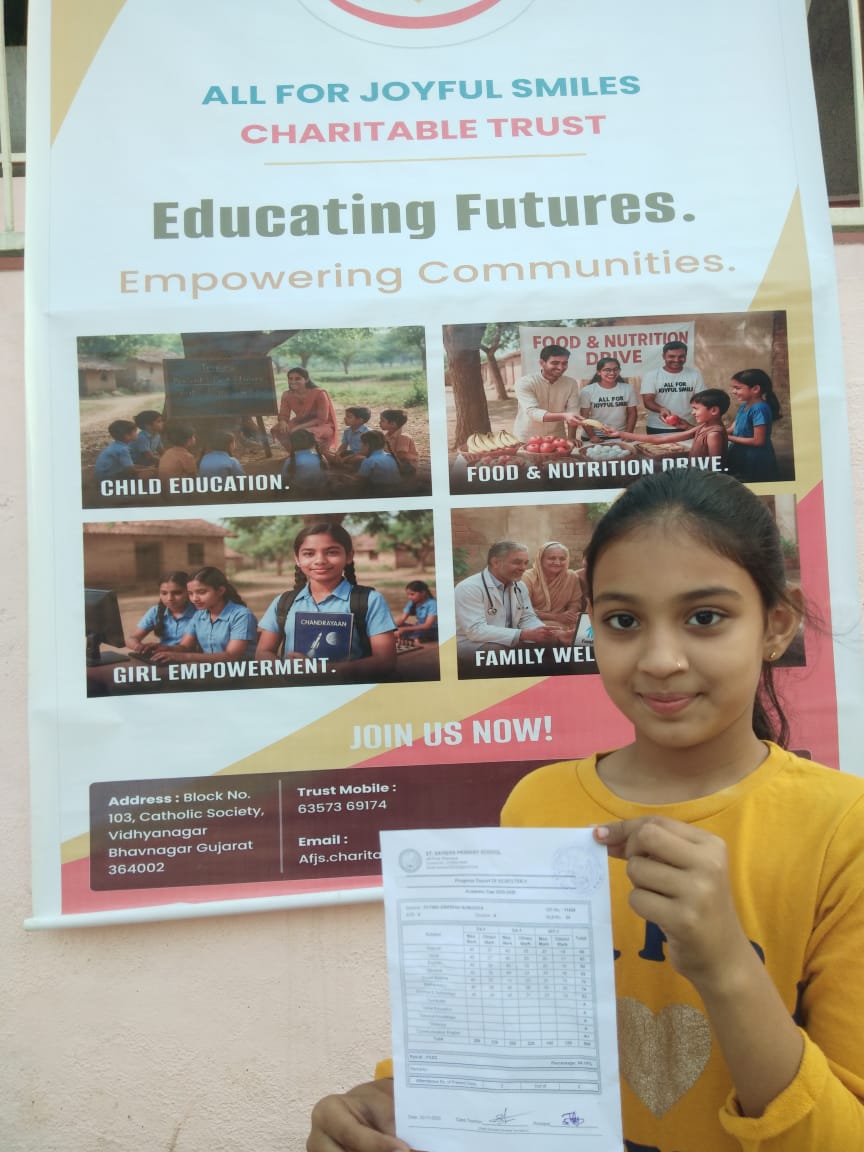
Girl Empowerment Through Education: Why It Changes Everything
The numbers are stark. In India, approximately 40% of girls drop out of school before completing secondary education. In Gujarat's underprivileged communities, this number is even higher, and in the specific communities AFJS Trust serves in Bhavnagar, we see it firsthand.
Girls who were in our programme last year. Girls who are not, this year. The reasons vary, but they are almost always the same underneath: economics, expectations, and the quiet assumption that a girl's education is a luxury the family cannot afford.
We disagree. Here's why.
Why Girls Drop Out: The Real Reasons The surface explanation is usually money. The family can't afford the fees. But the deeper reasons are more complex and more stubborn:
Economic pressure: In households where every member's contribution matters, daughters are often expected to take on domestic work, including cooking, childcare, and household labour, that allows other members to work. School interrupts this. School, from a certain perspective, is a cost and not an investment.
Early marriage: In several of the communities we work in, girls are considered of marriageable age from 15 or 16. Families worry that an educated girl will become harder to marry, or that continuing school will delay a marriage that is seen as the family's primary responsibility toward a daughter.
Safety: The walk to school, the journey home, the unsupervised hours: these are real concerns for families in under-resourced communities. A daughter who doesn't go to school can't face dangers on the road.
Cultural beliefs: Deep-rooted assumptions that education is more important for boys, that girls will "anyway leave" to another family, that their future is in the home, are not eliminated by school enrolment data. They require active engagement to shift.
The Multiplier Effect of Girls' Education The data on this is unambiguous and has been replicated across every region of the world:
- For each additional year of secondary education, a woman's earnings increase by 10 to 20 percent
- Educated mothers are far more likely to have educated children. The effect compounds across generations.
- Girls who finish secondary school are significantly less likely to marry before 18
- Children of educated mothers have dramatically lower rates of child mortality and malnutrition
- Communities where women are educated have higher civic participation, better governance, and lower rates of domestic violence
Educating girls is not a social justice cause. It is the most rational investment in community development available.
What AFJS Trust's Girl Empowerment Programme Does Our Girl Empowerment programme is built around a simple philosophy: identify the girls most at risk, address the actual barriers preventing their education, and stay with them.
We provide:
Full educational scholarships: School fees paid directly to St. Xavier's Primary School, Bhavnagar, so financial barriers are removed entirely.
Female mentors: Every girl in our programme is matched with a female mentor, often a young woman from the same community who has finished school. These mentors are not motivational speakers. They are proof. They are what's possible.
Confidence and life-skills workshops: Weekly sessions that address practical and psychological barriers including confidence, communication, body safety, legal rights, and career awareness. Girls in our programme report feeling seen and capable in ways they did not before.
Family engagement: We work with parents, not around them. Shifting parental attitudes about girls' education requires trust and time. Our community workers spend hours in conversation with mothers, fathers, and grandparents, presenting the data, sharing stories, and making the case that a daughter's education is the family's best investment.
A Real Story: Noor Noor was at serious risk of dropping out of St. Xavier's Primary School when AFJS Trust intervened. Her fees were in arrears. The school was preparing to ask her to leave. A donor's contribution paid her fees for the full academic year.
What happened next is why we exist. With her school place secure, Noor flourished. She won second place in the school's Rangoli competition, a certificate of achievement she earned in front of the entire school. Her teacher says she is one of the most focused students in her class. She wants to be an artist.
That is what girl empowerment looks like in practice. Not a policy statement. A girl who came to school, stayed, and discovered what she was capable of.
How You Can Help ₹25,000 sponsors one girl's complete year of education at St. Xavier's. ₹10,000 covers educational materials and tutoring support for a semester. Whatever you can give creates a ripple effect that extends far beyond the individual child.
Donate at joyfullsmiles.org/donate, or WhatsApp us at +91 63573 69174.
Real Change in Real Time Since our program began, we have supported over 150 girls in Bhavnagar and Ahmedabad. Many have gone on to pursue secondary education, a pathway their mothers never had.
Education is not just a right. For girls, it is a lifeline: for themselves, and for the generations they will raise.
John Dsouza
Founder & Secretary, AFJS Charitable Trust · Bhavnagar, Gujarat
John Dsouza grew up in Bhavnagar and founded AFJS Trust after witnessing the hardships of underprivileged children in his hometown. He leads day-to-day operations and programme delivery.
Ready to make a difference?
Your donation directly funds the work described in this article.